Love This Blog? Sign Up for Our Newsletter for More
SignupNo items found.


Undetected spam flags are a silent threat to outbound calling performance. Legitimate businesses can have their numbers labeled Spam Risk, Scam Likely, or Fraud Risk by carriers and analytics engines, driving down answer rates and negatively impacting revenue. Flags are assigned based on various number reputation signals. Call deliverability platforms like ARMOR® offer ongoing monitoring for outbound teams to identify false flags on numbers, as well as direct remediation with carriers to have these flags cleared when they appear.
Your team relies on the telephone to connect with prospects and customers every day. Spam flags can quietly undermine those efforts by displaying warning labels to contacts, silently sending your calls to voicemail, or blocking them entirely. That means lower answer rates, burned leads, wasted rep time, and missed revenue. And in many cases, you won't even know it's happening until the damage is done.
Understanding how to identify and remediate spam flags when they appear is essential for any business that depends on outbound dialing. Here’s why flags can be assigned to your numbers even when you place legitimate calls, how to identify them before they have a chance to wreak havoc on your outbound strategy, and what to do next.
Flags are not applied by carriers directly. Each major carrier works with a third-party analytics provider to analyze calling behavior in real time and flag numbers that appear suspicious or unwanted:
Carriers and analytics engines base spam flags on a variety of factors, and continually update alogorithms to improve labeling accuracy. Some factors include:
Because these algorithms are probabilistic instead of deterministic, false positives happen. A new number, a spike in dialing volume, or run of low call engagement can trigger flags, even if the caller is dialing contacts who want the calls. Flags also vary by carrier, region, and even time of day, which is why passive detection methods consistently fall short.
Related: How to Build a Trusted Number & Avoid Potential Spam Call Labels
Not all spam labels are the same. Here's what each major carrier may display to their subscribers:
Category labels like Telemarketer, Political, Account Services, Debt Collector, Nonprofit, or Survey can appear even without a full spam designation and may still reduce answer rates if recipients choose to screen those categories.
The first step in managing your number reputation is knowing when a flag is present, and on which carrier. But not every method commonly used to do this will produce equal results.
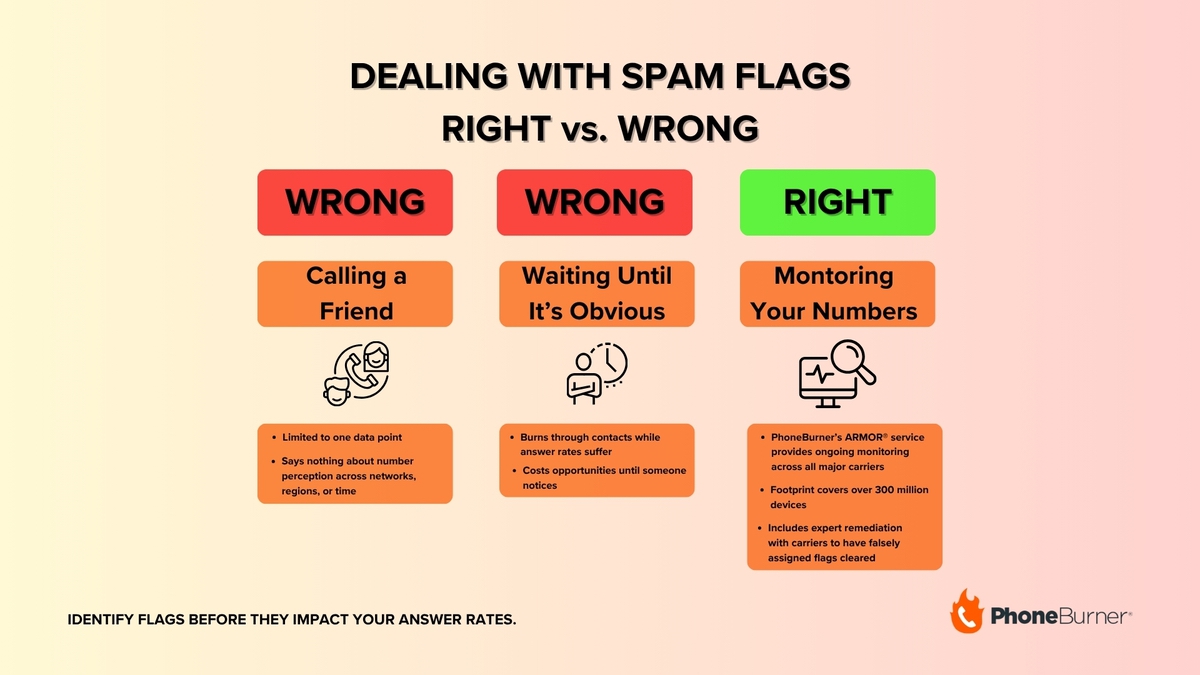
Asking a colleague how your number appears gives you one data point, at one moment, on one carrier. It tells you nothing about how your number is perceived across networks, regions, or time.
Dialing through a flagged number burns through contacts at a fraction of the answer rate you should be getting. By the time someone mentions it, you've already lost opportunities.
PhoneBurner’s ARMOR® service monitors your numbers across all major carriers on an ongoing basis and alerts you when a flag is detected. Our experts also remediate directly with carriers to have falsely assigned flags cleared from your numbers so you can continue using them.
Now, let’s talk about remediation and why it matters.
When a flag appears, the temptation is to discard the number and get a new one. This practice is known as number rotation, but it’s highly inadvisable for outbound teams.
A primary reason not to rotate flagged numbers for fresh ones is that spam callers frequently use similar tactics. That means carriers and analytics engines have learned to distrust new or recently activated numbers, especially those that quickly jump to high call volume, which the algorithms may view as higher potential for fraudulent or nuisance calls.
Replacing flagged numbers feeds a vicious cycle: a number gets flagged, you replace it with a new one, then start calling at high volumes with the same patterns and without established call history that carriers look for In response, they flag the new number, and you’re back to square one.
Another reason rotating backfires is that different numbers from the same organization still share a call fingerprint, and carriers have learned to connect the dots. New and rotated numbers can quickly be linked together and then flagged together.
Learn More: The Dirty Truth About Number Rotation: Why It’s Killing Your Trust, Brand, & Answer Rates
Each major carrier has its own submission process for requesting flag removal. You'll typically need to provide context about your calling practices, demonstrate compliance with telecom regulations, and make the case that the flag is based on incomplete or misleading data. Having your business numbers registered with carriers is also beneficial, since it signals to them that your calls are from a legitimate business and can strengthen your case during remediation.
Remediation timelines vary by carrier, and are subject to change based on case-specific circumstances. Many resolutions take days, but in some circumstances it can take a week or more.
Delays are typically due to backlogs at the carrier's analytics provider, not resistance. In some cases, providers may deny removal or re-flag a number, especially if they've gathered strong behavioral signals. When that happens, the right response is advocacy: reviewing call patterns, providing evidence of legitimate use, and escalating through the appropriate channels.
For businesses that want comprehensive number reputation management without managing the process themselves, PhoneBurner offers ARMOR® (Answer Rate Monitoring, Optimization, and Remediation) a done-for-you solution built directly into the PhoneBurner platform that includes:
Your outbound numbers aren’t disposable; they’re valuable assets that deserve to be protected. Build long-term number reputation that carriers recognize and trust, and enjoy higher answer rates with ARMOR®.
Once you’ve begun the remediation process for a flagged number, what should you do with it: continue using it or put it on pause until the flag is resolved? Whether to pause a flagged number depends on several factors:
Early flags are common and may resolve naturally as healthy call patterns emerge. Rather than pausing, gradually ramp usage while maintaining strong list quality and professional calling habits.
Pausing the flagged one and using another outbound number that has established call history can be a reasonable option while remediation proceeds, since it prevents you from losing more opportunities to the flag while the issue is addressed.
This is not the same as number rotation, since you aren’t swapping out the flagged number for a brand new one with no history. In fact, outbound teams with multiple numbers frequently spread calls across them to keep call volume and patterns consistent. You can learn more about this technique and how to do it efficiently with PhoneBurner below:
Learn More: Using PhoneBurner to Improve Number Management for Teams
In this case, pausing may not be realistic. The best course of action may be to continue using the number responsibly while you wait for your remediation request to be resolved. Consistent, legitimate call volume can actually support remediation by demonstrating to carriers that your calls are part of normal business activity.
In any case, replacing a number entirely should be a last resort. Consider this only after all other remediation options have been exhausted.
Remediation fixes problems after they happen, but healthy calling behavior makes them less likely to happen in the first place, and less likely to return.
Most factors determining spam flag risk come from carriers and analytics engines, but some can come from consumer behavior as well. That’s because consumer complaints are one factor that most carriers consider when deciding to assign spam flags.
Here’s a quick table of some steps you can take to make flags less likely on both the carrier and consumer side of things:
And always keep sales and support calls on separate numbers to ensure more consistent calling patterns and engagement patterns, and to make call data and analytics more useful and actionable.
Remember: number reputation is built over months of consistent, respectful calling behavior. The businesses that maintain the highest answer rates aren't the ones replacing numbers most aggressively; they're the ones that prioritize number reputation and treat phone numbers like long-term assets.
Ongoing spam flag monitoring isn't optional for teams that depend on the phone. It’s critical for identifying spam flags before they have a chance to significantly weaken your answer rates and giving you a pathway towards clearing them so your team can keep connecting effectively.
The combination of carrier registration, continuous monitoring, and expert remediation gives your numbers the best chance of reaching the contacts you've worked hard to earn. Don't let a label you didn't know about undo the effort your team puts into every call.
It’s time to protect your outbound numbers. Try ARMOR® with PhoneBurner and keep calling with confidence.
A spam flag is a label applied to a phone number by a carrier's analytics provider that alerts subscribers the incoming call may be unwanted. Depending on a subscriber's settings, flagged calls may display a warning label, be sent to voicemail, or be blocked entirely.
No. Flags are applied on a carrier-by-carrier basis, and may even be specific to certain regions. A number may be flagged on Verizon but clean on AT&T, or flagged in one city but not another. This is why monitoring across carriers and regions is essential for maintaining a healthy number reputation.
Spam detection systems process call patterns — call volume, call duration, answer rates, call frequency — and consumer feedback, then compares them against known spam patterns. The problem is that legitimate outbound programs can produce patterns that look similar to spam traffic: new numbers dropped into high-volume campaigns, low connect rates, short calls that end before voicemail.
There's also a factor that tends to go unacknowledged: legitimate businesses can still place calls that recipients find unwanted or bothersome. Calling too frequently, reaching people who don't remember opting in, or calling outside normal hours all generate negative engagement such as hang-ups, declined calls, and spam reports, that feed directly into how your number gets classified. A call that feels like a nuisance registers as one, regardless of whether it's compliant.
A spam or fraud flag indicates the call is likely malicious or unwanted. A category label (like Telemarketer or Debt Collector) identifies the type of caller without necessarily implying fraud. However, both can prevent your calls from displaying your business information clearly, and either can reduce answer rates if recipients choose to screen calls with certain category labels.
Common remediation timelines vary by carrier and can be anywhere from a couple of days to potentially weeks. Timelines depend on the bandwidth of each carrier's analytics provider and other factors. Keep in mind that sometimes carriers reject removal requests, and will not remove a flag unless and until patterns have materially changed.
If a carrier denies removal or re-flags a number, the next step is to review call patterns and provide additional evidence of legitimate use. In persistent cases, PhoneBurner's ARMOR® team can escalate and advocate on your behalf if data it, though carrier decisions ultimately remain outside any third party's direct control.
In most cases, no. Replacing numbers feeds the exact cycle that makes new numbers more likely to be flagged, and ignores the underlying causes of those flags leading to new ones. The better path is remediation and adjusting calling practices. Replacement should only be considered as a last resort after all remediation options have been exhausted.
ARMOR® is PhoneBurner's optional spam protection service that includes automatic carrier registration, ongoing number monitoring, proactive flag remediation, and advanced answer rate analytics. PhoneBurner numbers with ARMOR® protection average higher answer rates than PhoneBurner numbers without it.
No service can guarantee flag removal, as final decisions rest with carrier analytics providers. However, our team takes every reasonable step, including direct negotiation with carriers and providing supporting documentation, to push for a fair outcome.
Remediation success depends on many factors including lead quality, call practices, and consumer feedback. That said, the ARMOR® service consistently resolves over 85% of flags and has successfully remediated hundreds of thousands of flags for its customers.